
Thumbs Up
Digit
digits are the parts at the very end of the arms or legs of a creature. Our fingers and toes are all digits.Trait
any distinguishing factor or quality that can vary in a group. Eye color and height are examples of traits that we can easily see.Descendants
people that come from a previous generation. You are the descendant of your parents and grandparents, but also the descendant of species that evolved and lived in Africa millions of years ago.Ancestor
an organism from which others have evolved. In humans, a relative from whom one is descended, who lived at least several generations ago.Before you begin
This experiment will demonstrate the importance of opposable thumbs.
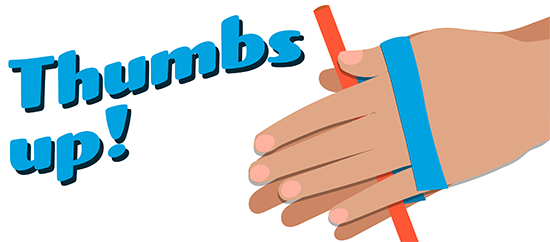
Our opposable thumbs let us grasp and manipulate objects. When you tape down your thumb, you’ll get a sense of how hard it would be to do many things if our hands were shaped differently. Even a simple task like placing a straw in a bottle becomes difficult! Why do you think human hands are shaped the way that they are?
What you will need
- Painter’s tape
- Drinking straw
- Empty plastic bottle with cap
- Trash container
- Info sheet [PDF]
Procedure

Have someone help you apply the tape to your hands so you cannot bend or move your thumbs.

Try to do some simple things, like picking up the straw. Try to put the straw into the bottle. Now, remove the straw and try to place the cap onto the bottle.
Learn more
Our closest living relatives, chimpanzees, have hands that are similar to ours. Their hands allow them to use some simple tools, like using a stick to get ants out of anthills. But they don’t have a brain like ours, so they can’t plan out making complex tools, and they don’t improve on the design of their tools over time.

All living things have evolved through time in response to their environment. Many millions of years ago, the ancestor to all living primates developed an opposable digit on its hands and feet, which allowed it to cling to branches in the trees where it lived. This trait became beneficial to survival and was passed to all the descendants of that ancestor species.
The opposable digit has evolved differently for different species. For example, like most primates, chimps retained their “thumbs” on both their hands and feet. Colobus monkeys have greatly reduced the thumbs on their hands, because these monkeys no longer needed an opposable digit for how they move. Humans have a thumb on our hands, but we no longer have an opposable big toe.
Bibliographic Details
- Article: Thumbs Up
- Author(s): Amy Peterson
- Publisher: Arizona State University
- Site name: ASU - Ask An Anthropologist
- Date published:
- Date modified:
- Date accessed: September 16, 2026
- Link: https://askanexpert.asu.edu/anthropology/experiments/opposable-thumb-activity
APA Style
Amy Peterson. ( ). Thumbs Up. Retrieved September 16, 2026, from https://askanexpert.asu.edu/anthropology/experiments/opposable-thumb-activity
American Psychological Association, 6th ed., 2nd printing, 2009.
For more info, see
the APA citation guide
.
Chicago Manual of Style
Amy Peterson. "Thumbs Up." ASU - Ask An Anthropologist . Published . Last modified . https://askanexpert.asu.edu/anthropology/experiments/opposable-thumb-activity.
Chicago Manual of Style, 17th ed., 2017.
For more info, see
the Chicago Manual citation guide
.
MLA Style
Amy Peterson. Thumbs Up. ASU - Ask An Anthropologist . , https://askanexpert.asu.edu/anthropology/experiments/opposable-thumb-activity. Accessed September 16, 2026.
Modern Language Association, 8th ed., 2016.
For more info, see
the MLA citation guide
.
What does an anthropologist do? Answer >>
Experiment Packet
Be Part of
Ask An Anthropologist
By volunteering, or simply sending us feedback on the site. Scientists, teachers, writers, illustrators, and translators are all important to the program. If you are interested in helping with the website we have a volunteers page to get the process started.
