
Discover: Hadar, Ethiopia
The science of paleoanthropology begins with discoveries in the field. And it is exciting to find a real fossil! The famous fossil "Lucy" was discovered in 1974 by Donald Johanson in the dusty hills of Hadar, Ethiopia. Scientists continue to return to the same area to look for more fossils of our ancient ancestor, Australopithecus afarensis, along with the fossil skeletons of animals that lived around the same time—3.2 million years ago. Follow along as a group of scientists and students trek out to the field in search of fossils!
Image credits Benjamin Reed

After supplies and equipment are packed for the six-week field season, the caravan of trucks heads out through Addis Ababa, the capital city of Ethiopia, to the field.

On the road, Ethiopia
The view quickly opens up to the beautiful African landscape.

Camels getting a ride, Ethiopia
Now, that is something you don't see everyday!

Caravan of trucks, Ethiopia
A long drive out to the field over dirt roads and tough terrain.

Setting up bathrooms, Hadar, Ethiopia
Everyone helps to set up camp. And the first, most important thing—bathrooms!

"Camp Hadar," Awash Valley, Ethiopia
This camp is home for six weeks. There are tents for each person, a research tent, and a kitchen tent.

Outside classroom, Hadar, Ethiopia
In the field, the classroom may be under the shade of a nearby tree. Here, the team learns about the day's schedule and where they will be searching for fossils.

Students taking notes
Students use field journals to take notes—this is still school!

Students walking up the hill
The search begins for new fossils. In this area of Ethiopia, fossils erode out of the soil through time, wind, and the scarce rain that falls. You have to keep a sharp eye to the ground—you may just spy part of an ancient antelope skull just below the surface!

The top of the hill, Hadar, Ethiopia
The soil is examined to see if it is the correct geological area for searching for new hominin, or ancient human ancestor, fossils. Geologists know from working in the area for the past 40 years, which layers will possibly have fossils they are looking for.

Fossil tooth
It takes a trained eye to spot this fossil tooth in the dirt.

Begin the dig!
The team can begin to dig where a fossil tooth has been found to see what else might turn up. Yellow flags indicate where fossils are seen coming out of the hillside.

Setting up the dig site
The site is divided into meter squares so that fossils can be recorded as to where they are found and in what geological layer for dating the fossil.

Careful excavation techniques
Careful excavation techniques are used to make sure fossils are not missed. After digging out the shelf, the dirt is put in to a bucket.

The dirt is sifted through a large sieve to look for the smallest fossil teeth or bones.
The dirt is sifted through a large sieve to look for the smallest fossil teeth or bones.

A jaw bone, Hadar, Ethiopia
If the team is lucky, they will find more than a small tooth. Here is a jaw bone from some creature, but from what kind of animal? More work will need to be done to determine if it is from a modern animal, an ancient animal, or a fossil from one of Lucy's species Australopithecus afarensis.

Cleaning fossils and bones from the field work
Back at camp, all the bones found in the field are cleaned . . .

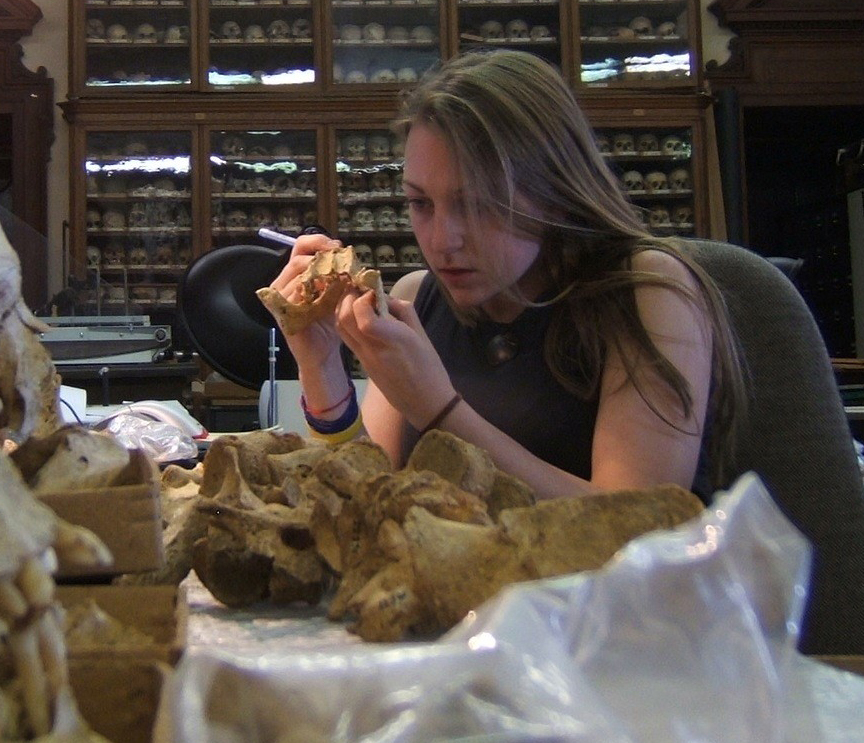
Which animal is this from?
. . . and compared to modern animal bones or casts of fossils to determine exactly what this fossil is.

Computers in the field
The day's finds are catalogued into a computer. On the table are some casts of fossil skulls brought along to use for comparison and artifacts found in the field.

Cooling off in the Awash River
After a long dusty day, students cool off in the Awash River. There are crocodiles around, so they have to keep a sharp eye out!

A student with a satellite phone
This far away from any city, only satellite phones work. A student is using the phone connected to a solar charging pad.

Field kitchen, Hadar, Ethiopia
In the evening, a local Afar cook, hired for the field season, will provide a good meal for the team. The team relies on local Afar people to help with setting up camp, security, cooking, and field work. A few individuals or several generations of families have been part of the field team for many years.

Field team, Hadar, Ethiopia, 2009
The entire field team—scientists, students, and local Afar partners—pose for a photo before the end of the season. Many of the graduate students from this 2009 group have graduated with their PhDs and are on to careers in universities, medical schools, and business.
What does an anthropologist do? Answer >>
Be Part of
Ask An Anthropologist
By volunteering, or simply sending us feedback on the site. Scientists, teachers, writers, illustrators, and translators are all important to the program. If you are interested in helping with the website we have a volunteers page to get the process started.


