


The Brainy Branch
Lineage
a sequence of ancestor and descendant species through time.Adaptation
a physical or behavioral trait of an organism that evolved by natural selection and helps the organism survive and reproduce.Australopithecus
an extinct genus of hominins that lived in South and East Africa from 4.2 to 2.0 million years ago.Hominin
humans and all of their extinct relatives. Some of the best known hominin genera include Australopithecus, Paranthropus, and our genus, Homo.Paleoanthropologist
a scientist that specializes in the study of human evolution.Our species, Homo sapiens, are incredibly unique among the species on Earth today.
There are many thousands of species across the world, from microscopic bacteria to massive whales. And many more species have become extinct since life arose on our planet. But humans are the only upright walking, large-brained, tool-using species alive today.
Humans and Hominins
It wasn’t always that way. Over the past 50 years, scientists have discovered the fossil evidence of at least a dozen hominin species. “Hominin” is the name for the ancient ancestors to our species Homo sapiens that are more closely related to us than to any other living species. Many different types of hominins lived at the same time. They could have even lived near or among each other. These fossil ancestors have been found at excavation field sites in Africa, Asia, and Europe.
One early group of hominins (called a genus) is Australopithecus. This group lived over a roughly two million year period, from about four million to 1.9 million years ago. Due to environment or resource conditions, most branches of the Australopithecus line became extinct. One branch—Australopithecus afarensis—survived until around three million years ago. Many anthropologists believe that this branch evolved to become the earliest evidence of the Homo genus.
Over several million years, the genus Homo also had many member species living at the same time. Neandertals, a member of the Homo genus, lived at the same time as modern Homo sapiens. But only one branch of Homo continued to survive to become today’s modern human.
Choosing a path

Scientists who study the evolution of our human past from fossil evidence are paleoanthropologists. They use scientific methods to interpret and understand the relationships between all of these fossil species.
ASU researcher William Kimbel is a paleoanthropologist. He was a college student studying anthropology when the fossil skeleton “Lucy” was discovered. Lucy, one of the best-known fossil hominins, is a member of the species Australopithecus afarensis.

The Lucy skeleton was on loan from Ethiopia to the Cleveland Museum of Natural History in 1975. Kimbel’s professor at the time was Donald Johanson, who discovered Lucy in 1974. Alongside Johanson, Kimbel had the rare opportunity to examine this original fossil. Inspired by this experience, Kimbel began a career studying Lucy’s species. He also formed a scientific partnership with Johanson, which has lasted over 40 years.
Inspired by the possibility of new discoveries, Kimbel chose a career in anthropology. The discovery of such an old and complete fossil like Lucy raised questions about our human heritage. It also promised future answers. More fossils were still buried in Hadar, where Lucy was discovered, and other fossil-rich field sites around Africa.
Bigger Better Brains
Kimbel now studies how the bone structure of Australopithecus developed. In particular, he examines changes in the skull. The skull had to change to accommodate bigger brains that later hominins have, which then affects the development of the face. Most important were changes in the transition to standing upright and walking on two legs, called bipedalism.
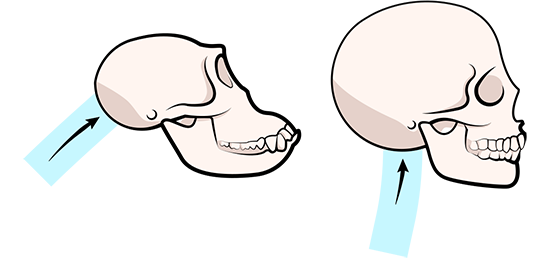
When a species stands upright, the hole where the brain stem meets the spine has to move underneath the skull. Changes like this allow scientists to understand things about how a fossil species moved, just from the skull!
Kimbel has compared different Australopithecus species with each other. He looked at features of Ardipithecus ramidus, or “Ardi” in comparison with Lucy’s species. He has shown that certain features set the stage for the development of our own genus Homo. The differences include the shape of hand and foot bones, a shrinking of the canine teeth, and diet.
Professor Kimbel has shown that Lucy’s species would have been able to do things that Ardi had not been able to do. These differences are known to have helped later human ancestors survive in a changing climate. This includes upright walking and using stone tools. Upright walking also allowed ranging over a larger area for a wider variety of food sources. Most importantly, the development of a larger brain did not occur until well after Ardi’s time.
Throughout his career, Kimbel has worked to learn about the origins of our species. He has found new fossils. He has studied differences in hominin species. And he has asked questions about how our ancestors lived. Through scientific inquiry, he has contributed to our knowledge about the human lineage.
Making connections

Perhaps more importantly, professor Kimbel is working to connect different kinds of researchers to work together. These researchers can then share information within the field of paleoanthropology. As any anthropologist will tell you, human cooperation enables us all to achieve extraordinary things.
Professor Kimbel cofounded a group called the African Rift Valley Research Consortium (ARVRC). This group of scientists are working in Ethiopia, Kenya, and Tanzania. Their goal is to share data between members’ projects and research sites. Together, they can answer questions about human evolution that couldn’t be answered by one project alone.
Overall, there are 10 different research projects and 40 researchers from many different organizations. Groups within ARVRC focus on different topics. Kimbel leads a group that seeks to answer questions about the hominin diet. They are focusing on the diet of Australopithecus afarensis. They want to understand how diet changed along the human lineage.
Starting in 2014, Kimbel led a team of scientists from ASU’s Institute of Human Origins (IHO) in research about what makes humans unique. There were 11 projects, each taking a collaborative approach to human origins research. These projects focused on where, when, and how unique human traits emerged. Humans have complex brains that allow us to vividly experience the world. Humans learn from others how to adapt to new environments and to create new tools.

We cooperate with each other so that we can accomplish big tasks, trade, and care for people who cannot care for themselves. This work allowed IHO scientists to learn about what makes us unique in nature—the only species of our kind!
______
William Kimbel earned his undergraduate degree in anthropology from Case Western Reserve University and PhD in 1986 from Kent State University.
His field research has taken him to Hadar (Ethiopia), Olduvai Gorge (Tanzania), Israel, Kenya, South Africa, and Tunisia. Bill Kimbel is the Director of the Institute of Human Origins and the Virginia M. Ullman Professor of Natural History and the Environment in the School of Human Evolution and Social Change at Arizona State University.
Bibliographic Details
- Article: The Brainy Branch
- Author(s): Amy Peterson, Alexandra Norwood
- Publisher: Arizona State University
- Site name: ASU - Ask An Anthropologist
- Date published:
- Date modified:
- Date accessed: October 16, 2026
- Link: https://askanexpert.asu.edu/anthropology/profiles/brainy-branch
APA Style
Amy Peterson, Alexandra Norwood. ( ). The Brainy Branch. Retrieved October 16, 2026, from https://askanexpert.asu.edu/anthropology/profiles/brainy-branch
American Psychological Association, 6th ed., 2nd printing, 2009.
For more info, see
the APA citation guide
.
Chicago Manual of Style
Amy Peterson, Alexandra Norwood. "The Brainy Branch." ASU - Ask An Anthropologist . Published . Last modified . https://askanexpert.asu.edu/anthropology/profiles/brainy-branch.
Chicago Manual of Style, 17th ed., 2017.
For more info, see
the Chicago Manual citation guide
.
MLA Style
Amy Peterson, Alexandra Norwood. The Brainy Branch. ASU - Ask An Anthropologist . , https://askanexpert.asu.edu/anthropology/profiles/brainy-branch. Accessed October 16, 2026.
Modern Language Association, 8th ed., 2016.
For more info, see
the MLA citation guide
.

What plants and animals lived with our ancient ancestors? Answer >>
Be Part of
Ask An Anthropologist
By volunteering, or simply sending us feedback on the site. Scientists, teachers, writers, illustrators, and translators are all important to the program. If you are interested in helping with the website we have a volunteers page to get the process started.


