
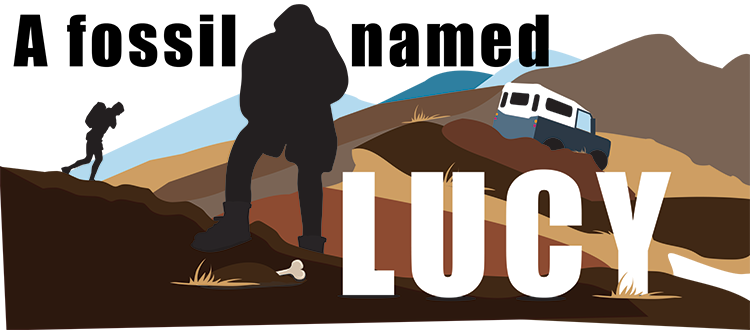
A Fossil Named Lucy
Bipedalism
the ability to move about on two legs (like a human) instead of four legs (like a dog or a chimpanzee).The field of paleoanthropology is a young science. There have been many paleoanthropologists over the years who have found many important fossils. But, even by the early 1970s, we didn't know everything about human evolution—and we still don't!
Back then, reserachers knew a few key events in human evolution and how they make us different from our primate cousins. But, they did not know which events happened first, which is very important to understanding why humans evolved the way we did.
Scientists knew three basic things about what makes humans unique but didn’t know for sure which came first. These three things were that humans:
- Have big brains
- Make and use tools
- Walk on two legs
For a long time, these earlier scientists thought that our ancestors grew their large brains first, then began walking on two feet to keep their hands free to make and use tools.
We now know that these events happened in the opposite order: Bipedalism, or walking upright on two legs, evolved before human ancestors gained their big brains or toolmaking abilities. Since these key discoveries were made, our understanding of human evolution has improved considerably!
It is due to scientists like Donald Johanson that we have answered these important questions about human evolution.
A natural scientist

Donald Johanson was interested in animals and biology since he was a young boy. He would find lizards, frogs, and other small animals and keep them in jars and boxes in his room. Although Johanson was not a great student, a neighbor who was an anthropologist encouraged the young Johanson to study science.
Johanson studied chemistry, then anthropology in college. He went on to study anthropology for his PhD. Over that time, his interest in human origins grew. He was determined to make an important discovery that would add to our understanding of how we “became human.”
His first trip to Africa was in 1970 while he was in college. He returned each year to work in archaeological field sites in Ethiopia, excavating ancient fossil animals. He was always hoping to discover something more—fossils of a human ancestor!
"Lucy" in the desert

On November 24, 1974, Donald Johanson had been searching for fossils in the dusty hills of Hadar, Ethiopia. He and his student Tom Grey decided to walk a different route back to the Land Rover. As they walked, Johanson saw something that would change the world. He saw a fossil ulna—an arm bone—sticking out of the side of a gully.
Over the next two weeks, the field research team excavated the site. They found 40 percent of a single fossil skeleton—an incredibly large portion to find from such a long time ago. From these bones, the scientists identified a new species of human ancestor and named it with the scientific name, Australopithecus afarensis.

That skeleton would come to be known around the world as “Lucy,” named for The Beatles song, “Lucy in the Sky with Diamonds,” which was on the tape player in camp while they worked.
Lucy is special for a number of reasons. The fossil bones were dated to be 3.2 million years old. At the time she was discovered, she was both the most complete and oldest fossil ancestor ever found. The skeleton also gave scientists clear evidence that millions of years ago, this species was a bipedal, upright walking human ancestor. She also showed that our ancient ancestors had a mix of human-like and ape-like traits—though she walked upright all the time, her brain was only a bit larger than a modern chimpanzee’s.
Learning from Lucy

Since Lucy’s discovery, many fossils that are older or more complete have been found. But Lucy is still one of the most important fossils ever discovered, mostly because of when she was found. Lucy put Ethiopia on the map as a cradle for early human life. The discovery also sparked new research into our ancestry, which has helped to answer great questions about where and how humans evolved.
Professor Johanson believes that one of the most important parts of being a scientist is talking about what he has learned to everyone else. He has written many books and travels the world talking about Lucy and our human origins.
His first book, Lucy: The Beginnings of Humankind, inspired many people to study anthropology. Other books include From Language to Lucy, Lucy’s Child, and Lucy’s Legacy. He has also made many TV appearances including as the host of a PBS NOVA series—In Search of Human Origins. The show explores when people first began to walk, talk, and use tools and was seen by more than 100 million people worldwide.
Becoming Human
He also played a key role in the making of a film and a website—Becoming Human. The website, which won a Webby award, is a valuable resource for students of all ages. These types of media help people who aren’t scientists learn about human origins and bring this knowledge to people of all educational levels.
Donald Johanson’s career has undoubtedly changed both the field of paleoanthropology (the study of the origins of the human species) and the way that the world thinks about human evolution. Johanson continues to talk to groups around the world to increase public awareness of the fact that all humanity shares a common African ancestry going back to Lucy and beyond. Spreading this knowledge encourages people to be curious about how we developed as a species and about the world around us.

Donald Johanson is the Founding Director of the Institute of Human Origins and the Virginia M. Ullman Chair of Human Origins in the School of Human Evolution and Social Change at Arizona State University. He has done field research in Ethiopia, Yemen, Saudi Arabia, Egypt, Jordan, and Tanzania. Professor Johanson continues to travel, lecture, and teach an online course about human origins.
Bibliographic Details
- Article: A Fossil Named Lucy
- Author(s): Amy Peterson, Alexandra Norwood
- Publisher: Arizona State University
- Site name: ASU - Ask An Anthropologist
- Date published:
- Date modified:
- Date accessed: September 15, 2026
- Link: https://askanexpert.asu.edu/anthropology/profiles/fossil-named-lucy
APA Style
Amy Peterson, Alexandra Norwood. ( ). A Fossil Named Lucy. Retrieved September 15, 2026, from https://askanexpert.asu.edu/anthropology/profiles/fossil-named-lucy
American Psychological Association, 6th ed., 2nd printing, 2009.
For more info, see
the APA citation guide
.
Chicago Manual of Style
Amy Peterson, Alexandra Norwood. "A Fossil Named Lucy." ASU - Ask An Anthropologist . Published . Last modified . https://askanexpert.asu.edu/anthropology/profiles/fossil-named-lucy.
Chicago Manual of Style, 17th ed., 2017.
For more info, see
the Chicago Manual citation guide
.
MLA Style
Amy Peterson, Alexandra Norwood. A Fossil Named Lucy. ASU - Ask An Anthropologist . , https://askanexpert.asu.edu/anthropology/profiles/fossil-named-lucy. Accessed September 15, 2026.
Modern Language Association, 8th ed., 2016.
For more info, see
the MLA citation guide
.

Don Johanson answers one of life's big questions -- what makes us human?
Be Part of
Ask An Anthropologist
By volunteering, or simply sending us feedback on the site. Scientists, teachers, writers, illustrators, and translators are all important to the program. If you are interested in helping with the website we have a volunteers page to get the process started.


