
Glacier
a large body of ice, like those in Antarctica.Tuber
a large, tough underground part of a plant, like a potato.Hominin
humans and all of their extinct relatives. Some of the best known hominin genera include Australopithecus, Paranthropus, and our genus, Homo.Sagittal crest
a ridge of bone running along the middle of the top of the skull in some hominin species. This ridge of bone anchored the large chewing muscles of some Australopithecus and Paranthropus species. Sagittal crests are also found in other types of mammals, like spotted hyenas.Australopithecus
an extinct genus of hominins that lived in South and East Africa from 4.2 to 2.0 million years ago.Genus
a category that groups closely related species.Climate change and new faces
As the seasons change, your food resources probably don’t. In many parts of the world, you can go to the grocery store and buy most of the same foods throughout the year. Whether you want strawberries in the heat of summer or the chill of winter, you can find them.

New kids on the block
Shortly after three million years ago, two new groups of hominins appear in the fossil record. One, Paranthropus, had large jaws and teeth and skulls with tall sagittal crests to anchor big chewing muscles. The other was our genus, Homo. Our earliest ancestors had smaller jaws and teeth and more lightly built skulls than Paranthropus.
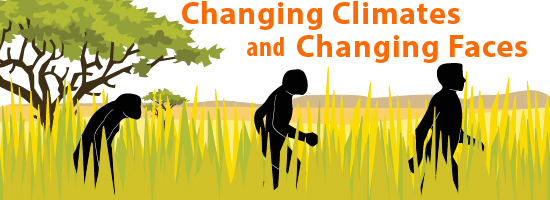
The appearance of both Homo and Paranthropus in the fossil record, 2.8 to 2.7 million years ago, has been tied to major global cooling during that time. To the north of the globe, glaciers started forming and expanding 2.8 million years ago. The glaciers never reached Africa, but they did cause big changes to the climate—Africa became much more arid, or drier. Trees have a hard time growing in areas with low rainfall, so grasses spread during this time.
Climate change and new hominins
![The lightly built skull and small teeth of Homo erectus. H. erectus consumed (and may have cooked) a lot of animal meat, which is softer and more easy to chew than plants. By Rama (Own work) [Public domain], via Wikimedia Commons.](/sites/default/files/anthropology/assets/stories/Changing_Climate/homo_georgicus_250w.jpg)

I think I found a fossil/artifact! What should I do with it? Answer >>
Be Part of
Ask An Anthropologist
By volunteering, or simply sending us feedback on the site. Scientists, teachers, writers, illustrators, and translators are all important to the program. If you are interested in helping with the website we have a volunteers page to get the process started.


