
Skip to main content Report an accessibility problem ASU Home My ASU Colleges and Schools Sign In
Arizona State University logo
Ask An Anthropologist
  • Home
  • Activities
    • All Activities
    • Coloring Pages & Worksheets
      • Human Skeleton
      • Human Skull
      • Yo-Yo Skeleton
    • Experiments
      • Being an Archaeologist
      • The Hunt for DNA
      • Hand Made
      • Head to Head
      • Pull it off
      • Thumbs Up
      • Tool test
    • Teacher Toolbox
      • Words To Know
    • Lucy in Space
      • High School First Place Winner
      • High School Second Place Winner
      • High School Third Place Winner
      • Middle School First Place Winner
      • Middle School Second Place Winner
      • Middle School Third Place Winner
    • Quizzes
      • A Brief History of History
      • Babies, Birth, and Brains
      • Because Your DNA Says So (quiz)
      • Brains over Brawn
      • Chipping Away
      • Controlling the Code (quiz)
      • Life is Spelled A, T, C, G
      • Off to the Field We Go
      • Our Primate Heritage
      • Team Primates
      • Technology and Human Learning
      • The Setting for Science
      • There's no I in Human
      • To the Laboratory!
      • When Did Our Brains Get Big?
    • Puzzles
    • Image Galleries
      • Discover: Hadar, Ethiopia
      • Discover: Mossel Bay
  • Stories
    • All Stories
    • World of Anthropology
      • A Brief History of History
      • Babies, Birth, and Brains
      • Because Your DNA Says So
      • Brains over Brawn
      • Changing Climates and Changing Faces
      • Chipping Away: Tools in the Stone Age
      • Chomp Into the Past
      • Controlling the Code
      • Fossil Hunters
      • Fossils Rock: How Geology is Used in the Fossil Record
      • Historical Human Habitats
      • Life is Spelled A, T, C, G
      • Off to the Field We Go
      • On the Origin of Species
      • Our Primate Heritage
      • Team Primates
      • Technology and Human Learning
      • The Setting for Science
      • The Tales of Teeth
      • There's no I in Human
      • To the Laboratory!
      • Walking Upright: A Tale of Two Legs
      • When Did Our Brains Get Big?
      • Who Are You?
    • Stories in other languages
      • Bebés, nacimiento y cerebros
      • Cerebros versus masa corporal
      • Controlando el código
      • El origen de las especies
      • El relato de los dientes
      • Equipo Primates
      • La vida se deletrea A, T, C, G
      • Las preguntas más populares
      • Nuestra herencia primate
      • Una breve historia de la historia
      • ¿Cuándo comenzaron nuestros antepasados humanos a caminar sobre dos pies y cómo lo sabemos?
      • ¿Cuándo nuestros antepasados humanos utilizaron herramientas de piedra?
      • ¿Cuándo nuestros cerebros se hicieron grandes?
      • ¿Cómo afectaron los cambios en el clima de la Tierra a nuestros antepasados humanos?
      • ¿Cómo es ser un antropólogo en el campo?
      • ¿Por qué el tamaño de nuestro cerebro cambió con el tiempo?
      • ¿Por qué los humanos cooperan entre sí y viven en grupos?
      • ¿Qué hace un antropólogo?
      • ¿Qué plantas y animales vivieron junto con nuestros antiguos ancestros?
      • ¿Qué podemos aprender sobre el desarrollo humano al estudiar a chimpancés y babuinos?
      • ¿Qué pueden decirnos las rocas y los sedimentos sobre cómo nuestros antiguos ancestros se desarrollaron en los últimos 4 millones de años?
    • Top Questions
      • How did changes in the Earth’s climate affect our human ancestors?
      • I think I found a fossil/artifact! What should I do with it?
      • What can rocks and sediments tell us about how our ancient ancestors developed over the last 4 million years?
      • What can we learn about human development from chimpanzees and baboons?
      • What does an anthropologist do?
      • What is it like to be an anthropologist in the field?
      • What plants and animals lived with our ancient ancestors?
      • When did human ancestors begin walking on two legs and how do we know?
      • When did human ancestors use stone tools?
      • Why did the size of our brains change over time?
      • Why do humans cooperate and live in groups?
    • Listen & Watch
      • A Human Climate
      • Chimpanzee Mother and Babies
      • Could other species evolve into humans? w/ Donald Johanson
      • Discovery: The Fossil Jaw of Homo
      • How did you know where to find Lucy? w/ Donald Johanson
      • How should we treat other species and the planet? w/ Donald Johanson
      • How will humans look 1,000 years from now? w/ Donald Johanson
      • In the Field: Exploring Pondoland, South Africa
      • Looking into Lucy
      • Skeleton Secrets
      • What did we learn from Lucy? w/ Donald Johanson
      • What makes us human? w/ Donald Johanson
    • Meet Our Anthropologists
      • Ancient Ecosystems
      • The Brainy Branch
      • Mussels, Migration and Microliths
      • A Fossil Named Lucy
  • Contact
    • Contact Us
    • Ask A Question
    • Information Collected
    • Volunteers
    • Permissions
    • Feedback
    • Question Guidelines
  • About
    • About Us
    • Credits
    • Articles and News
    • Contribute
    • Links
    • Site Map
Skip to main content Report an accessibility problem ASU Home My ASU Colleges and Schools Sign In
Arizona State University logo
Ask An Expert
  • Home
  • About
    • About Us
    • Contact Us
  • Discover More
    • Ask A Biologist
    • Ask An Anthropologist
    • Ask An Earth and Space Scientist
  • Support Us
  • Ask A Question
  • Teacher's Toolbox
  • Listen and Watch 
Ask An Anthropologist
  • All Activities
  • Coloring Pages & Worksheets
  • Experiments
  • Teacher Toolbox
  • Lucy in Space
  • Quizzes
  • Puzzles
  • Image Galleries

Discover: Hadar, Ethiopia

The science of paleoanthropology begins with discoveries in the field. And it is exciting to find a real fossil! The famous fossil "Lucy" was discovered in 1974 by Donald Johanson in the dusty hills of Hadar, Ethiopia. Scientists continue to return to the same area to look for more fossils of our ancient ancestor, Australopithecus afarensis, along with the fossil skeletons of animals that lived around the same time—3.2 million years ago. Follow along as a group of scientists and students trek out to the field in search of fossils!

Image credits Benjamin Reed

Heading out from Addis Ababa, Ethiopia

After supplies and equipment are packed for the six-week field season, the caravan of trucks heads out through Addis Ababa, the capital city of Ethiopia, to the field.


On the road, Ethiopia

The view quickly opens up to the beautiful African landscape.

Camels getting a ride, Ethiopia

Now, that is something you don't see everyday! 

Caravan of trucks, Ethiopia

A long drive out to the field over dirt roads and tough terrain.

Setting up bathrooms, Hadar, Ethiopia

Everyone helps to set up camp. And the first, most important thing—bathrooms!

"Camp Hadar," Awash Valley, Ethiopia

This camp is home for six weeks. There are tents for each person, a research tent, and a kitchen tent.

Outside classroom, Hadar, Ethiopia

In the field, the classroom may be under the shade of a nearby tree. Here, the team learns about the day's schedule and where they will be searching for fossils.

Students taking notes

Students use field journals to take notes—this is still school!

Students walking up the hill

The search begins for new fossils. In this area of Ethiopia, fossils erode out of the soil through time, wind, and the scarce rain that falls. You have to keep a sharp eye to the ground—you may just spy part of an ancient antelope skull just below the surface!

The top of the hill, Hadar, Ethiopia

The soil is examined to see if it is the correct geological area for searching for new hominin, or ancient human ancestor, fossils. Geologists know from working in the area for the past 40 years, which layers will possibly have fossils they are looking for.

Fossil tooth

It takes a trained eye to spot this fossil tooth in the dirt.

Begin the dig!

The team can begin to dig where a fossil tooth has been found to see what else might turn up. Yellow flags indicate where fossils are seen coming out of the hillside.

Setting up the dig site

The site is divided into meter squares so that fossils can be recorded as to where they are found and in what geological layer for dating the fossil.

Careful excavation techniques

Careful excavation techniques are used to make sure fossils are not missed. After digging out the shelf, the dirt is put in to a bucket.

The dirt is sifted through a large sieve to look for the smallest fossil teeth or bones.

The dirt is sifted through a large sieve to look for the smallest fossil teeth or bones.

A jaw bone, Hadar, Ethiopia

If the team is lucky, they will find more than a small tooth. Here is a jaw bone from some creature, but from what kind of animal? More work will need to be done to determine if it is from a modern animal, an ancient animal, or a fossil from one of Lucy's species Australopithecus afarensis.

Cleaning fossils and bones from the field work

Back at camp, all the bones found in the field are cleaned . . .

Which animal is this from?

. . . and compared to modern animal bones or casts of fossils to determine exactly what this fossil is. 

Computers in the field

The day's finds are catalogued into a computer. On the table are some casts of fossil skulls brought along to use for comparison and artifacts found in the field.

Cooling off in the Awash River

After a long dusty day, students cool off in the Awash River. There are crocodiles around, so they have to keep a sharp eye out!

A student with a satellite phone

This far away from any city, only satellite phones work. A student is using the phone connected to a solar charging pad.

Field kitchen, Hadar, Ethiopia

In the evening, a local Afar cook, hired for the field season, will provide a good meal for the team. The team relies on local Afar people to help with setting up camp, security, cooking, and field work. A few individuals or several generations of families have been part of the field team for many years.

Field team, Hadar, Ethiopia, 2009

The entire field team—scientists, students, and local Afar partners—pose for a photo before the end of the season. Many of the graduate students from this 2009 group have graduated with their PhDs and are on to careers in universities, medical schools, and business.
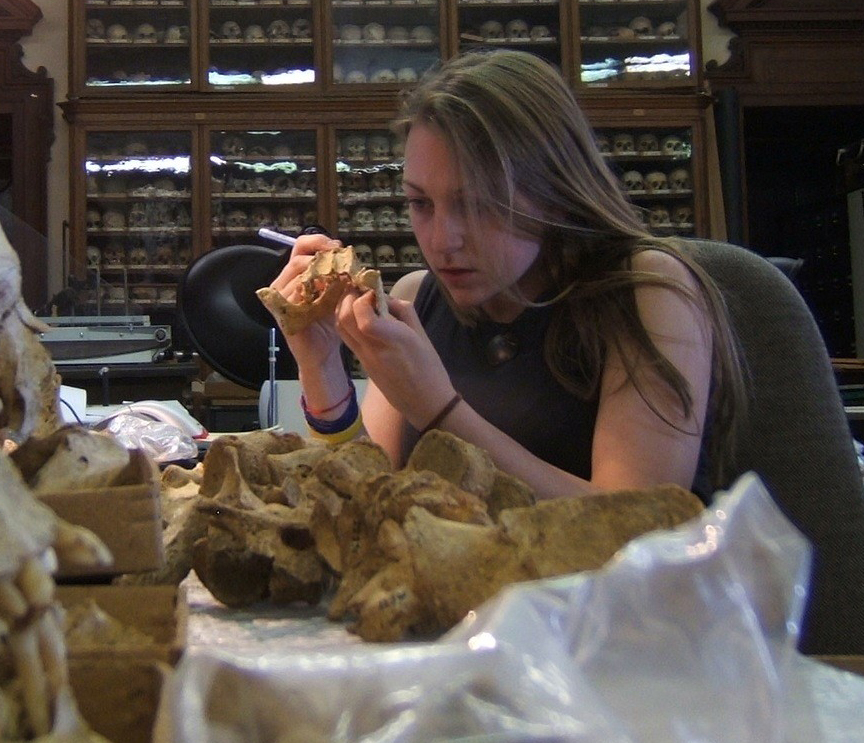
A bioarchaeologist at work in the lab

What does an anthropologist do? Answer >>

Be Part of
Ask An Anthropologist

By volunteering, or simply sending us feedback on the site. Scientists, teachers, writers, illustrators, and translators are all important to the program. If you are interested in helping with the website we have a volunteers page to get the process started.

 Contribute

Share this page

iho logo
A research unit of
The College of Liberal Arts and Sciences
templeton logo
Funded by the
John Templeton Foundation
becoming human logo
Ask An Anthropologist
powered by Becoming Human
ASU Logo
Ask An Expert

Contact Us

Contribute

Quick Links
Ask A Biologist Ask An Anthropologist Ask An Earth and Space Scientist
Maps and Locations Jobs Directory Contact ASU My ASU
Repeatedly ranked #1 on 30+ lists in the last 3 years
Copyright and Trademark Accessibility Privacy Terms of Use Emergency
ASU Logo
Ask An Anthropologist

Contact Us

Contribute

Quick Links
Ask An Expert Ask A Biologist Ask An Earth and Space Scientist
Tools
Ask A Question Feedback Teacher’s Toolbox
Usage
Guidelines Permissions
Maps and Locations Jobs Directory Contact ASU My ASU
Repeatedly ranked #1 on 30+ lists in the last 3 years
Copyright and Trademark Accessibility Privacy Terms of Use Emergency