

Lunar eclipse
when the Sun, Earth, and Moon are aligned and the Moon passes behind Earth, into its shadowMeteorite
a rock from space that lands on EarthAsteroid
A rocky object in our Solar System that is smaller than a planetAsteroid belt
a region in our Solar System between Mars and Jupiter where the majority of asteroids that orbit the Sun can be foundLander
a spacecraft capable of safely landing on a planetary surface.Rover
a space exploration vehicle that can move around on the surfaces of planets, moons, or other objects in the Solar System.Composition
the different materials that something is made out of.How do we know where meteorites come from?

On the evening of 21 January 2019, all eyes were on the Moon. It was a super blood wolf Moon. It was called this because it was a total lunar eclipse in the month of January. When all eyes and telescopes were focused on the Moon, something special happened. An object, about the size of a basketball, slammed onto the surface of the Moon. A bright flash followed. Where did this meteorite come from?
Most meteorites come from the asteroid belt between Mars and Jupiter. Some of them might also be ejected off the surface of Mars or the Moon. But how did we figure this out?
Well, there are several ways to know about a meteorite’s origin. It is like solving a cosmic puzzle:
a. When astronauts brought back rocks from the Moon as part of the Apollo missions, the chemistry of these Moon rocks matched some of the meteorites we had in our collections. This is how we identify ‘lunar meteorites’ or meteorites from the Moon.

b. The Viking landers and later rovers analyzed the atmosphere of Mars. The composition of the Martian air matched the composition of gases trapped in some of the meteorites from Mars.
c. Some telescopes on Earth or cameras on space-crafts observe asteroids. By studying the light reflected or absorbed by the surface of asteroids, we have an idea about what they look like and what minerals they are made of. We don’t always have to do this from a distance, either. We can also study the light reflected or absorbed by meteorites in the laboratory. If there is a match between the two patterns of light (called the spectra), we know a meteorite comes from a particular asteroid.
In case you are wondering, we do not know of meteorites that could possibly be from Mercury or Venus. At least, not yet!
Additional images via Wikimedia Commons. Asteroid 243 Ida by NASA.
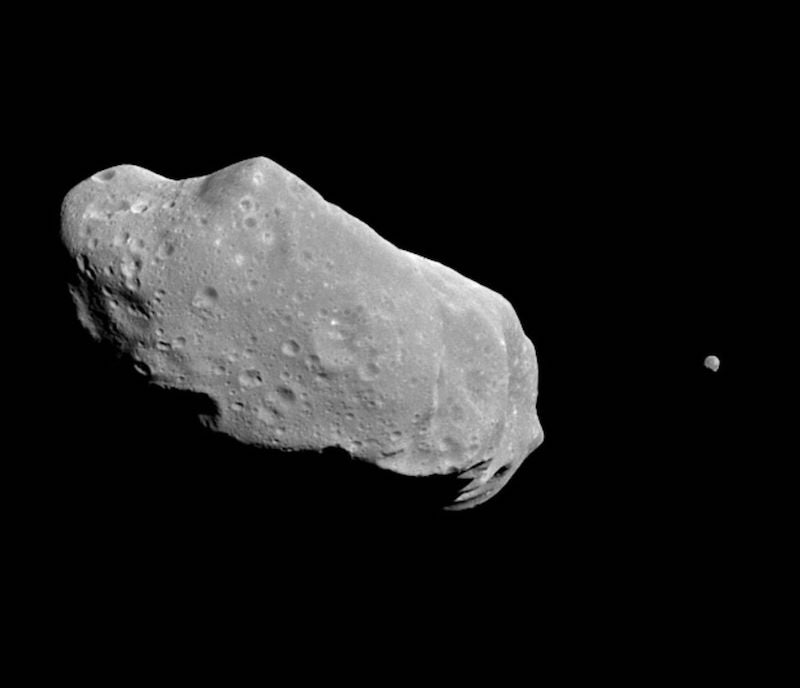
Most meteoriodes (and, eventually, meteorites) come from pieces of asteroids. Here we see asteroid 243 Ida.
Be Part of
Ask An Earth and
Space Scientist
By volunteering, or simply sending us feedback on the site. Scientists, teachers, writers, illustrators, and translators are all important to the program. If you are interested in helping with the website we have a volunteers page to get the process started.
